Dan Karuna on Living From Music With Covers and Originals
- From
- Bahia, Brazil
- Based in
- Florianópolis, Brazil
- Sound
- MPB, reggae, forró, samba rock
- Work
- Originals and covers
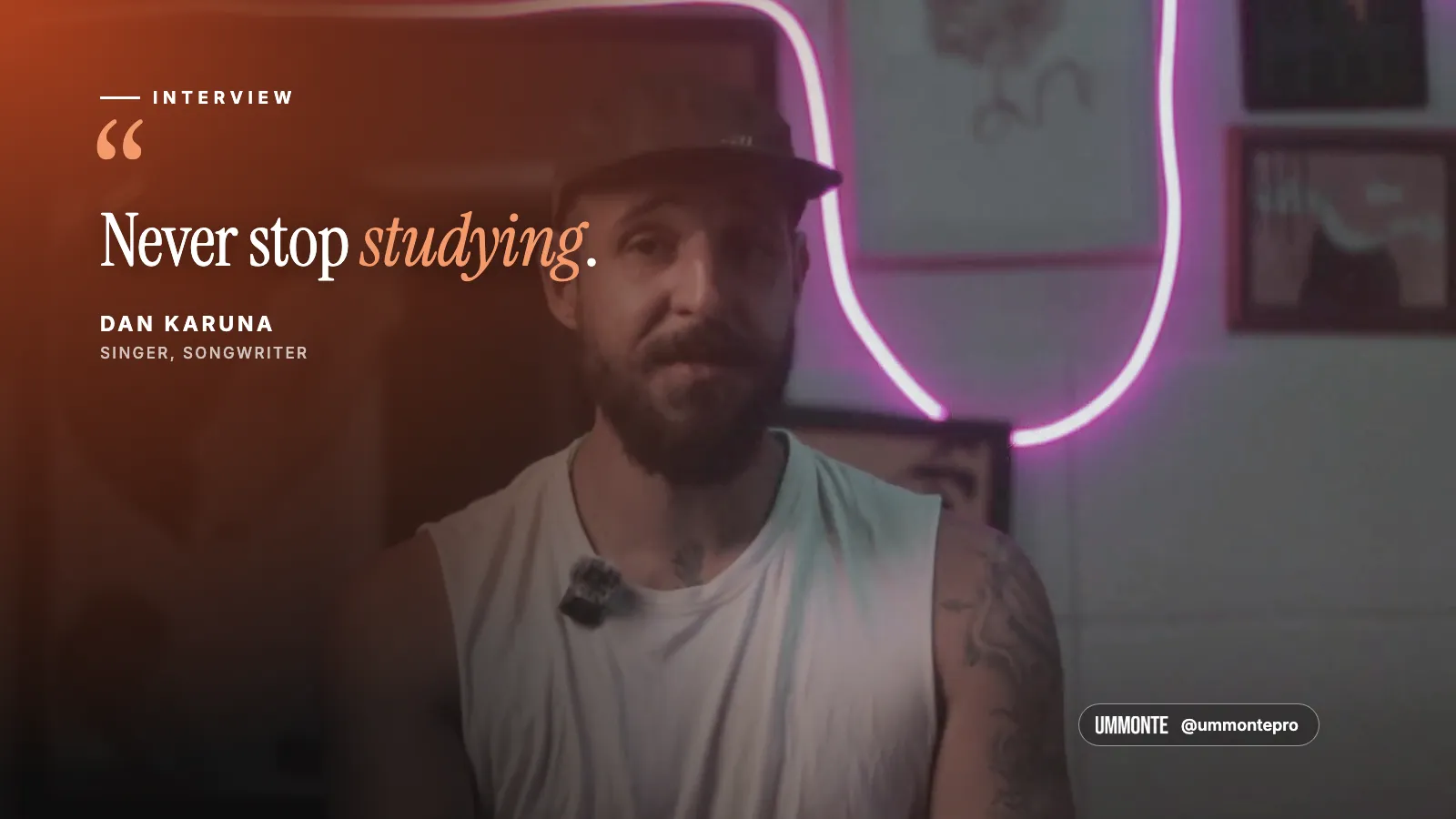
Dan Karuna is a singer and songwriter from Bahia who lives in Florianópolis. A musician, a writer and an entrepreneur of his own art, he was shaped by his family’s musicality and by the rhythms of the Brazilian Northeast. Moving between MPB, reggae, forró and samba rock, he built his identity by exploring his roots and trying new paths.
We talked with him about his creative process, the challenges of living from art, music as medicine, and what really matters for anyone who wants to make it a path. You can watch the full interview here. It is in Portuguese, and the answers below are our translation.
How did music start for you?
My mother still tells this story: the first song I made was at 4 years old. It wasn’t a great composition, just a little tune that came out of nowhere, a melody and a harmony, and everyone liked it. We formed a choir with the kids in my class to sing it at the school Christmas show, and by the end of the year everyone was singing my song.
Later, around 12 or 13, when you start having crushes, I began writing love songs. When I joined forró bands we played some of them, and I opened up to writing about other themes, not only romance. At 17, with my forró band, we entered a music festival in Bahia, the one at the State University of Southwest Bahia, with a song of mine called “O Forró Nunca Vai se Acabar” (“Forró Will Never End”), which stitches pieces of Luiz Gonzaga songs into one. We won first place.
Where did your sound change?
After college I moved to Belo Horizonte. There I started hearing a lot of new music that hadn’t reached me much in Bahia, and my head began jumping to other places. I started writing a lot of groove, a lot of samba rock. Today I still write more rootsy things from Bahia, from rhythms people don’t know that well, which flirt with samba. That’s where a lot of my roots are, because I grew up listening to it.
What is original music for you today?
A medicine. At first you write about crushes, because when you’re very young you can’t express what you feel for that person, so you try to boil it down into a song. Today my own music comes to me that way, as a remedy, as a way of explaining feelings to myself. And maybe a lot of other people identify with it and embrace that feeling, which could be theirs too. Original music is the medicine of our subconscious, an attempt to turn a feeling that’s hard to explain into something concrete.
How do you turn original music into a profession?
An important thing is to see which shelf of music you’re on. Not that you’ll make one single thing waiting for the audience’s reaction, but you should see who is walking a path similar to yours. That counts when it comes to which kind of playlist your music lands on at Spotify, next to which kind of artist. See where you’re heading: which festivals embrace your idea, which platforms or people are raising the same flag.
You have to love your art and romanticize it, but at the same time see it as a product, so you can value it and not stay at the margin of what others think of you. Audiovisual production, a music video, an interview, a documentary, all of it counts for a lot in adding value to your work. Build the cultural map of everything you have developed along the way: I played on that festival’s stage, I did this, I did that.
How do you live 100 percent from music?
By diversifying. Sometimes I’m closing a guitar gig, sometimes doing a project with someone else, sometimes just voice and guitar on my own, sometimes as a percussionist. If demand comes more from one side, I lean a bit toward it; if it comes from another, I lean the other way. If you stay in one closed niche, it’s hard to keep going. The more you diversify within music, the better. You’re a guitarist, but you also record online for other people, or you’re a producer, or you teach guitar. That way you’re always working, and you see where it’s hotter, where it’s colder.
I don’t like seeing myself inside bubbles, from music to religion. I like knowing many things, without isolating myself.
Never stop studying.
What about artificial intelligence?
Today the internet makes it possible to be seen and heard anywhere in the world. AI is everywhere right now, and I believe it is also, in a way, a re-democratization of certain kinds of access. Even if it’s scary to think it will take our jobs, I don’t think it will. Someone may lose work to a person who knows how to use AI, but the creative factor, the key point, will always be us in the middle of all this.
What advice do you give to people starting out?
Study, man. If you want to grow in music or in anything else in life, you have to study. Especially as a musician: besides music and singing, you have to study marketing, negotiating with clients, finances. You end up being everything. So my tip is to never stop studying, never stop going after knowledge, always with the mindset that we haven’t learned everything yet. Music is an infinite universe, anything can become music. Believe in what you’re doing and jump in.
The original interview is in Portuguese.