How to Write a Press Release for Your Music
Picture an artist with a release date and a blank page.
The single is done. The link is live. Now someone told them they need a press release, so they open a document and type the first line that sounds official: “Rising artist Mira Vale is thrilled to announce her powerful new single.”
Then they stop. It reads like every other announcement they’ve ever skipped.
That instinct is right. A press release isn’t a bio, and it isn’t an ad. It’s one page about one release, written so a stranger with forty unread emails can understand in half a minute what happened, why it might matter to their readers, and where to listen. That’s the whole job. Anything that doesn’t serve it is decoration.
When to send it
One to two weeks before the release. Earlier and it gets buried. Later and nobody has time to listen, let alone write. If you want a writer to hold the story until a certain day, that’s called an embargo, and it’s just a line at the top: “Embargoed until October 10.”
What goes in it
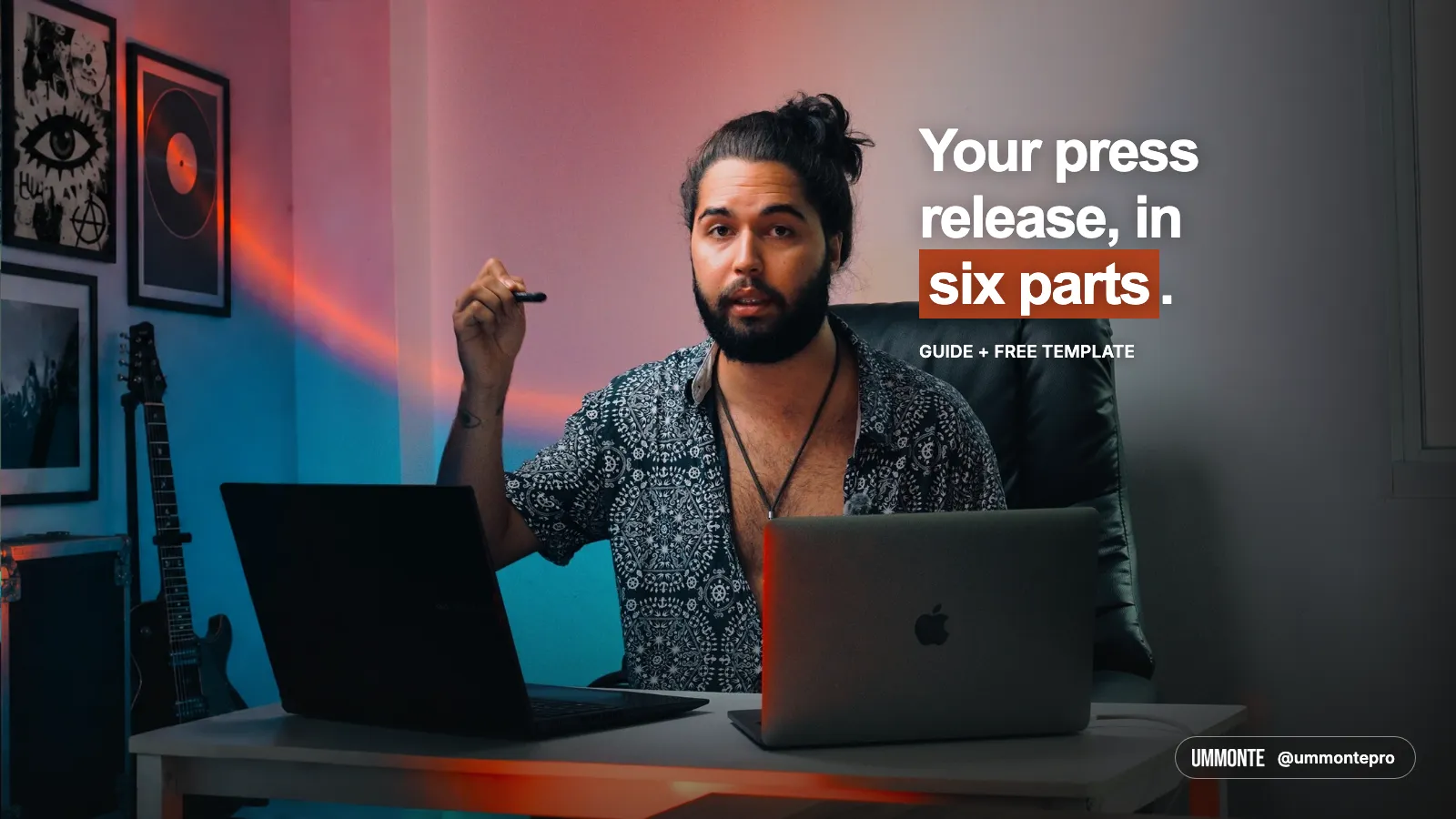
There are six parts, in this order:
- Headline. The news plus one strong detail. “Mira Vale releases ‘Low Light,’ recorded in one night in a friend’s kitchen.”
- Lead. The first paragraph. Who, what, where, when, why. If it’s the only paragraph they read, it still has to work.
- Context. Two or three sentences on how it was made, who was in the room, what it came from.
- Quote. One honest line from the artist. Something you’d say out loud, not something you’d put on a poster.
- Facts. Title, format, release date, credits, links, and where to find the cover art and photos.
- Bio and contact. Three lines about the artist, then a name, an email and a number that works.
That’s it. One page, maybe a little more.
The tone rule
Write it in the third person, directly, and cut every adjective you can’t prove.
“Explosive new single” proves nothing. “Recorded live in one take with a four-piece band” is something a person can picture. “Her most ambitious project yet” is a claim. “Her first record with strings” is a fact. Facts are what a writer can actually use, because they can lift them into their own sentence without checking anything.
A quick test: read each sentence and ask what a stranger could do with it. If the answer is nothing, it’s decoration. Cut it.
Where they usually go wrong
Most press releases fail in quiet ways. The headline announces that a release exists, which is the one thing nobody needs to be told. The lead buries the actual news in the third paragraph. The quote sounds like it was written by a committee. The links are for a private preview that expires on Friday. The contact is a social handle instead of an email.
And the photos. A release with no image is a release with half the chance of being covered. Send a link to a folder with a few high-resolution shots, credited, with no watermark, so nobody has to write back to ask.
Words you’ll see around it
A few terms come up once you start sending. The lead is your first paragraph. A pitch is the short personal email you send with the release, two or three lines about why this writer might care. A mailing list is the contacts you send to, ideally people who have covered something like your music before. Hi-res means an image big enough to print, usually 2000 pixels on the long side or more.
You don’t need a big list. Ten people who actually cover your kind of music will do more than a hundred who don’t.
One last thing
The press release isn’t the point. It’s what makes the point easy to find. The point is that the story is already written, the facts are already checked, and the material is already in one place when someone says yes.
That’s a different way to think about a release. Not as a moment you announce, but as something you get ready, quietly, so that when the door opens there’s nothing left to do but walk through it.
We put the whole structure into a fill-in-the-blanks template, so the blank page never gets to be blank. It’s free, and it’s yours to copy.
Get new posts by email
Ideas for independent artists. We will send a confirmation email. If you do not see it, check your spam folder.