Théo Mizú and Matheus Pasquali on Touring the World With Brazilian Music
- From
- São Paulo and Rio Grande do Sul, Brazil
- Based in
- Northern Thailand
- Project
- Théo Mizú & Banda
- Topic
- Touring internationally, on their own
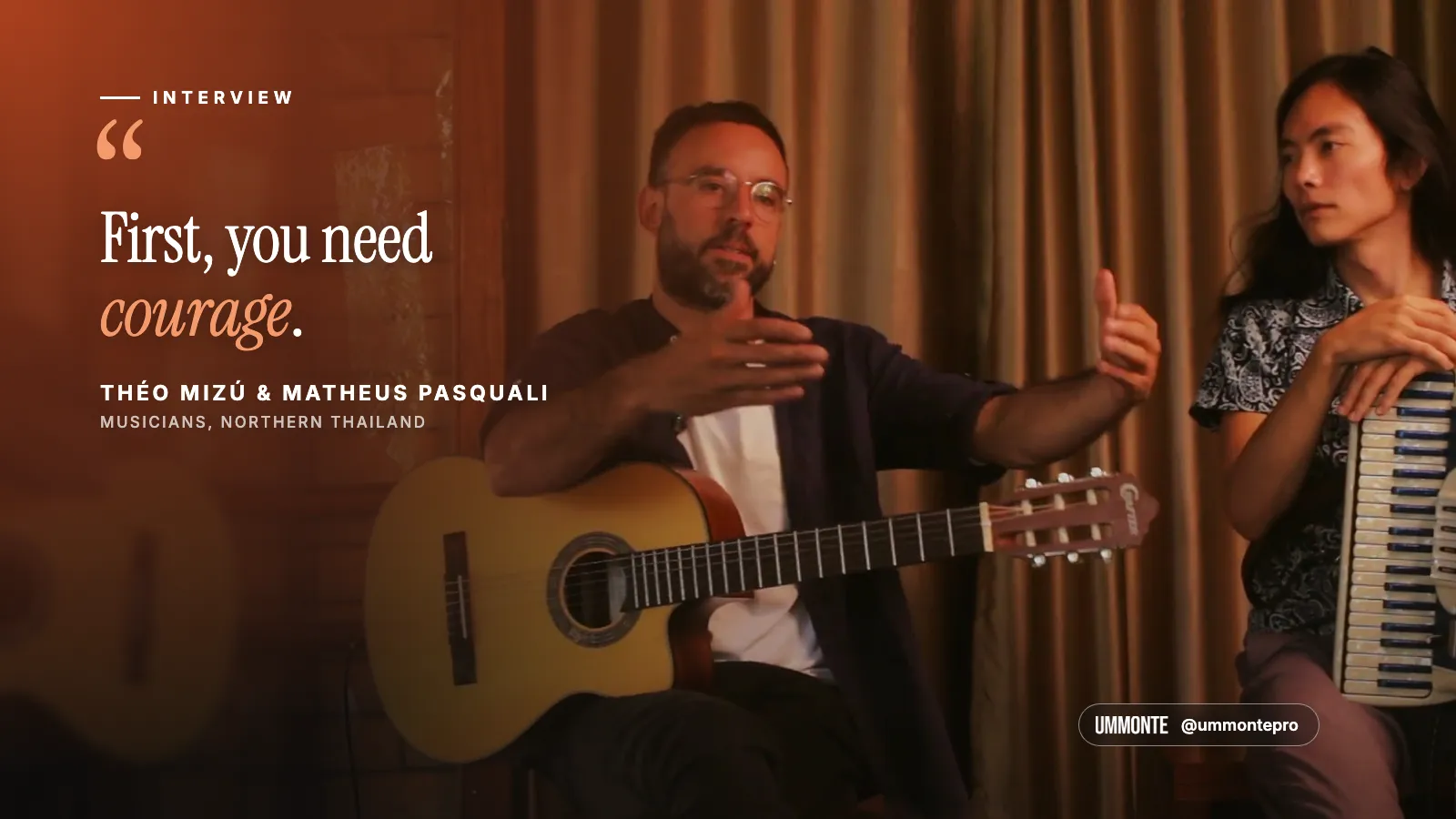
Théo Mizú is from São Paulo and Matheus Pasquali is from Rio Grande do Sul. When we spoke, both were living in a small village in Northern Thailand, part of the local artistic community, playing and collaborating. Théo had already done four tours in Europe, and Matheus plays with him in the project Théo Mizú & Banda.
We talked about the challenges and opportunities of living from music while traveling, about planning a tour, and about how good audiovisual material opens doors. You can watch the full interview here. It is in Portuguese, and the answers below are our translation.
How did you both end up there?
Théo: As Brazilians, we have an advantage in social situations: people receive us very well, and we receive foreigners well too. There is curiosity about our energy, our music, our culture. I started playing for foreigners very young, at 19, and Brazilian music was a door into many spaces and many musicians, who showed me references. They were musicians 10, 15, 20 years older than me, and I lived and played with them every day. That gave me the base of what my music is today.
Matheus: I’m from Rio Grande do Sul, and my whole professional path started there. I met Té in February, after Carnival, in São Paulo, through Fábio, who lives a life similar to the one Té has lived in recent years. He had recorded a song of mine in 2022. We started rehearsing every week, and Té said: I’m going to England in August, are you coming? I was teaching a lot, so I paused everything and went. I liked being abroad. Playing for foreigners was great, because people stood still, paying attention to exactly what you were doing. Gabriel and Té came straight to Thailand, and I went back to Brazil to finish my master’s degree. I spent about two weeks thinking about it. I put a full stop on it, and here we are.
How do you organize an international tour?
Théo: It’s the most laborious part, because it takes research and contact. Let’s invent a country: Mordor. Let’s tour Mordor. First, understand whether Mordor has the vibe of our music. Then find venues that can take our kind of sound and our show setup, and find ways to reach those people, by email, by phone, through contacts. Then a third job begins, organization and administration: building the best possible itinerary from the dates you have, while leaving room for the unexpected. It’s a strategy, almost a game. Then comes the practical part, tickets and accommodation, and during the tour, making sure everything that was agreed actually happens. It’s basically agency work.
I have done four tours in Europe, always with different bands but the same project. Before going with Matheus and Gabriel, I wrote a project explaining how I work, how I get these tours and how I see the value of that work, and presented it to them. We are a team, and I’m open to what they think.
Festivals close their bookings six to nine months ahead. In that window you have to spend about six hours a day looking for people, sending emails and following up. Today, in England, I already have a list of contacts who I know hire us: one time it was last minute, I sent a few emails and we got 16 shows. But before getting to that point, I would send a thousand emails to get ten replies, if that. That’s around 300 hours a month that go unpaid until the tour happens. That’s why, among us, a percentage of the fees goes to whoever does this organizing.
What role does good material play?
Théo: I started at 19 and, for me, this was my first career option. I was never happy with five little bar gigs a week to pay the rent. I always thought: a year from now, five years, ten. Ten years ago I was playing guitar alone. I wanted the project, in ten years, to be a band that could travel the world together on tours and at festivals. That’s what we are doing now.
In 2018, the first year of the project as a band, we played a street music contest in São Paulo and won, about 5,000 reais. We put that money straight into recording the best-produced video we have on YouTube. We hired a brass section and made it sound the way I had imagined the band. With that video, six people playing, a beautiful arrangement and quality image, I sold five tours. The importance of good material is priceless.
A website too. In Brazil we say: I have Instagram, I have so many thousand followers. But Instagram is niche. If you want to leave Brazil, you need to use other channels.
Matheus: What Té is saying should be taught in universities. It sounds obvious, but it isn’t. Most musicians don’t have this view, and it took me longer than necessary to understand it.
What are the paths for someone living from music?
Matheus: I spent my whole life in academia. My family said: you want to do music? Then study, do an undergraduate degree, a postgraduate degree. That’s one way. But music is a vast field. You can teach at a university, you can do what Té has done for ten years, go out into the world and try to sell, you can play bars five nights a week to pay the rent, write film scores, produce library music, work with mixing. The sooner you understand your own thing, the better, because you will need time.
What does it take to leave?
Matheus: First, you need courage. To be a musician and say: I’m really leaving, I’ll back this, I won’t give so much attention to the stability I might have. Second, a clear head. You’ll need resilience, sometimes strength, because the hard moments will come and you’ll be on your own. On the other hand, it’s the most fun thing in the world: playing with so many different people, experiencing so much. Be aware of the pros and cons. And if you can, do it young, because afterwards you start rethinking your whole life.
Théo: I was born in São Paulo and never managed to make my sound happen in my own city. I play a show there, ten people come at most. Meanwhile we go to England, play a place where nobody knows us and sell out: 150 tickets. If you want to make it happen, you have to take it seriously, like any career. Otherwise you stay stuck in a cycle until you’re 50, 60, doing the same thing. When you step out of your comfort zone, you see that things are possible that you would never have the chance to experience staying where you are.
First, you need courage.
The original interview is in Portuguese.