Merch and Print Basics
Merch and printed material are your identity as physical objects. They are also where mistakes cost real money. This step covers when to make them, what files you need and why colors change.
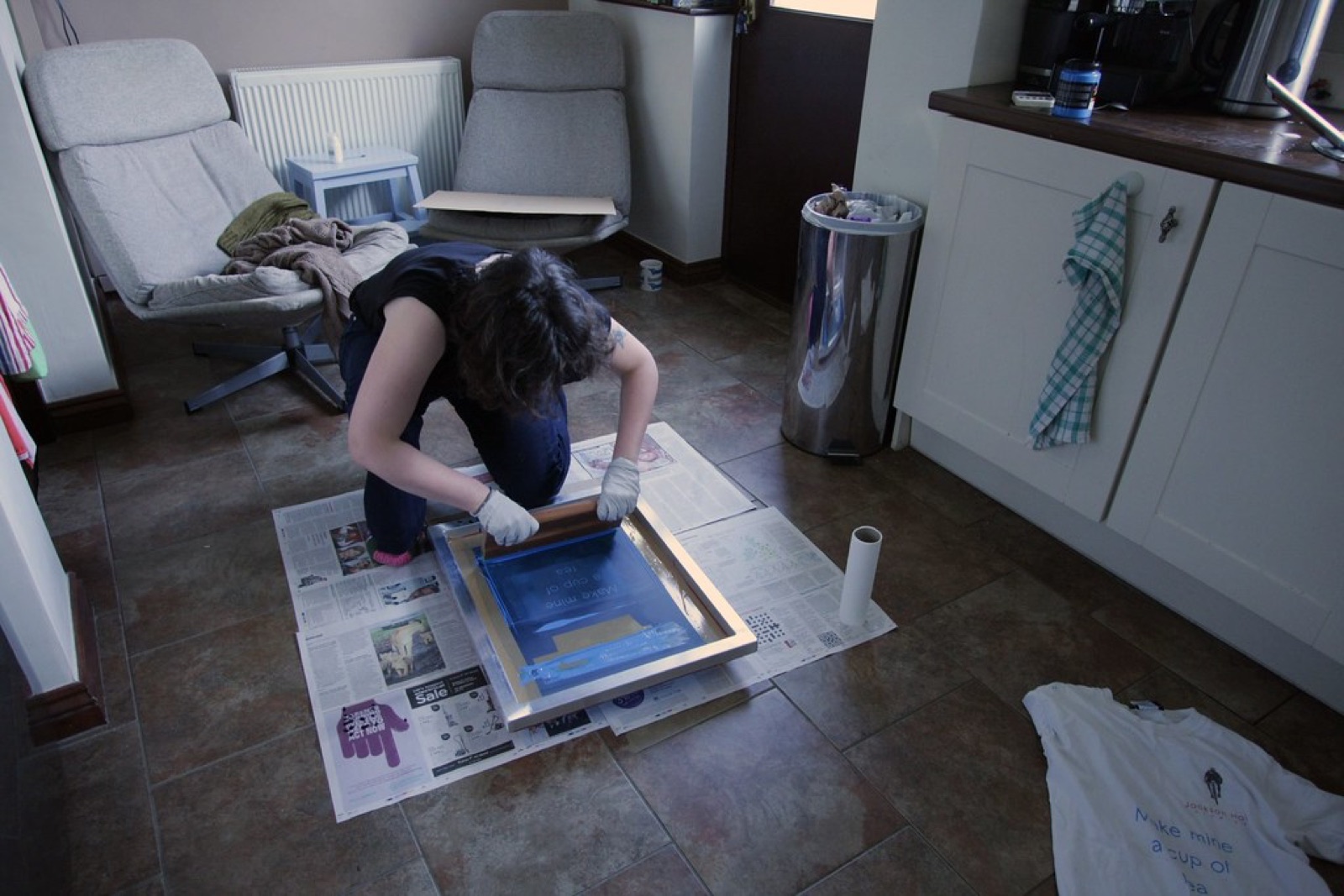 Photo: “Printing the first shirt” by Phil Gradwell, CC BY 2.0.
When merch makes sense
Merch works when people already want to take something home, which usually means you are playing shows or have an audience that asks. Start with one item and a small run.
Good first choices are cheap to make and easy to carry: stickers, a poster or print, a tote bag, one T-shirt design. Many print services produce items one at a time when ordered, which avoids boxes of unsold stock. The margin per piece is lower, and so is the risk.
Design from what you have
You already own the ingredients: wordmark, palette, the detail from step 10, your cover art.
The strongest designs are usually the simplest. A wordmark in one color on a good shirt gets worn. A full-color photo of your face mostly does not. Ask yourself whether you would wear it if it were another artist’s.
Make the thing people would want even if they had never heard the music. The name on it does the rest.
The files a printer needs
- Vector artwork (SVG, PDF or AI) for logos and type. Vectors can be enlarged without losing quality. This is why you exported one in step 9.
- High resolution for photos: 300 dots per inch at the final printed size is the usual standard
- Extra margin, called bleed, on paper prints, so nothing important is cut at the edge
- The printer’s own template whenever they offer one
Ask the printer for their specifications before you design, and ask for a proof before the full run.
Why colors change
Screens make color with light, and printers make it with ink. The same hex code will look different on paper, and different again on fabric.
Bright, glowing screen colors are the hardest to reproduce. Expect them to print duller. If an exact color matters, ask for a printed sample or choose from the printer’s physical color chart.
Screen printing on fabric is priced by the number of ink colors. A one or two color design is cheaper and often looks better.
Paper still works
A poster in a venue window or a card left on a table reaches people who never saw your profile. Use your template from step 20 and keep the same three levels of text.
Do this now
Sketch one merch item using only your wordmark and one palette color. Then look up one printer and read their file requirements.
We design merch and print pieces from the artist’s identity and deliver the files ready for the printer. See what we do.
If this is something your project needs, get in touch.
Get new posts by email
Ideas for independent artists. We will send a confirmation email. If you do not see it, check your spam folder.