What a Cover Has to Do
For decades a cover was a large printed object people held while they listened. Today it is mostly a small square on a screen, and it has more jobs than before. Knowing those jobs makes every design decision easier.
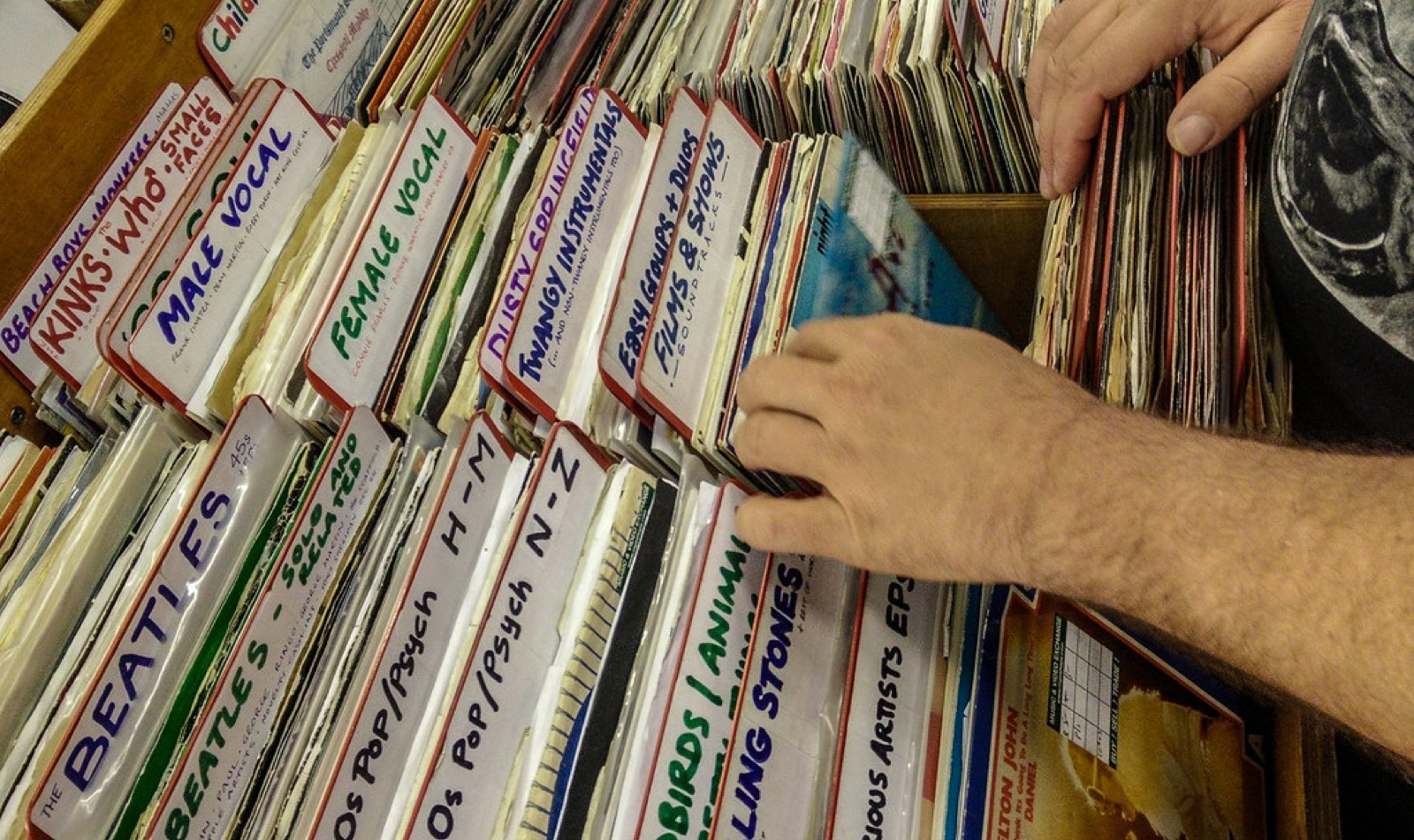 Photo: “Londres” by Maïlis Donnet, CC BY 2.0.
Job 1: get noticed small
In a release list or a playlist, your cover sits among dozens of others at the size of a postage stamp. Its first job is to be seen at all. That depends on contrast and simplicity far more than on detail.
Job 2: say what kind of music this is
Before pressing play, people guess the sound from the image. Dark and grainy suggests one thing, bright and glossy another.
This is where genre conventions come in. Every scene has visual habits. You can follow them, so the right listeners recognize the territory, or break them on purpose to stand out. Both are valid. What costs you is ignoring them by accident and sending a signal you did not mean.
Job 3: belong to you
Someone who has seen your earlier releases should suspect this one is yours before reading the name. That comes from the decisions you already made: palette, type, texture, the kind of image.
A cover has to be seen, has to hint at the sound, and has to look like yours. In that order.
What a cover does not have to do
It does not have to explain the song. Literal illustrations of the lyrics are rarely the strongest option.
It does not always need your name and title on it. Platforms show both right next to the image. Text on a cover is a style choice, and at small sizes it mostly disappears.
It does not need to carry everything. The cover is one piece of a system that also includes photos, videos and posts. We wrote about that shift in A Cover Used to Be the Whole Job.
Photo, illustration or type
Three common routes, each with a strength:
- A photo of you builds recognition of your face, useful early on
- An image or illustration builds a world around the music
- Type or pure graphics is bold, cheap to produce and easy to turn into a series
Pick the route that fits your three words and what you can repeat for the next releases.
Do this now
Open your last cover on your phone inside a streaming app, in a list, not on the release page. Score it from 1 to 5 on each of the three jobs.
Thinking through what a cover has to do for this release is where our artwork direction begins. Here is how we work.
If this is something your project needs, get in touch.
Get new posts by email
Ideas for independent artists. We will send a confirmation email. If you do not see it, check your spam folder.